Category: Our Projects

  • How to Build a Home on an Island: Challenges, Solutions, and Lessons Learned

    How to Build a Home on an Island: Challenges, Solutions, and Lessons Learned

    Building on an Island: What You Need to Know

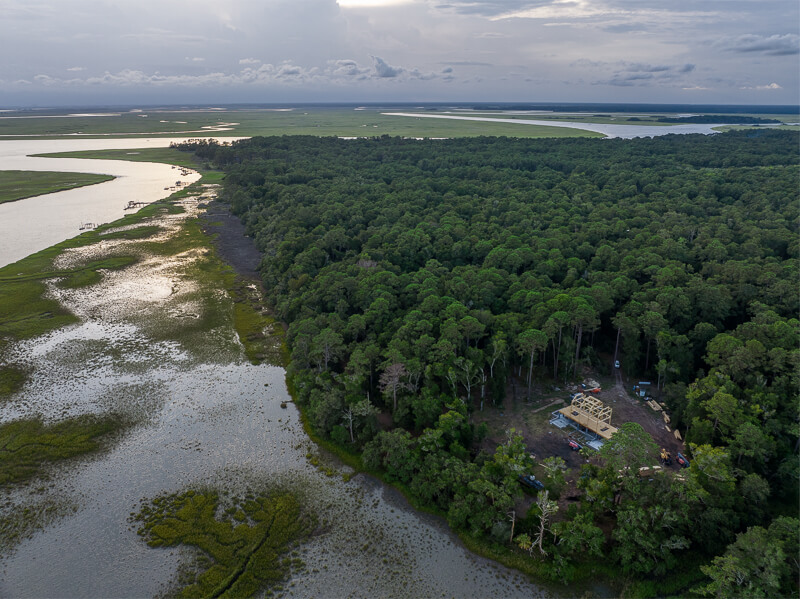
    Building a home on an island is a dream for many—but the logistics can quickly turn into a nightmare if you’re not prepared. From transporting materials by barge to dealing with unpredictable weather, island construction presents unique challenges. As a timber frame subcontractor specializing in complex builds, Carolina Timberworks recently completed an island project, and we’re sharing what we learned to help you plan your own remote build.


    Why Building on an Island is Different Than the Mainland
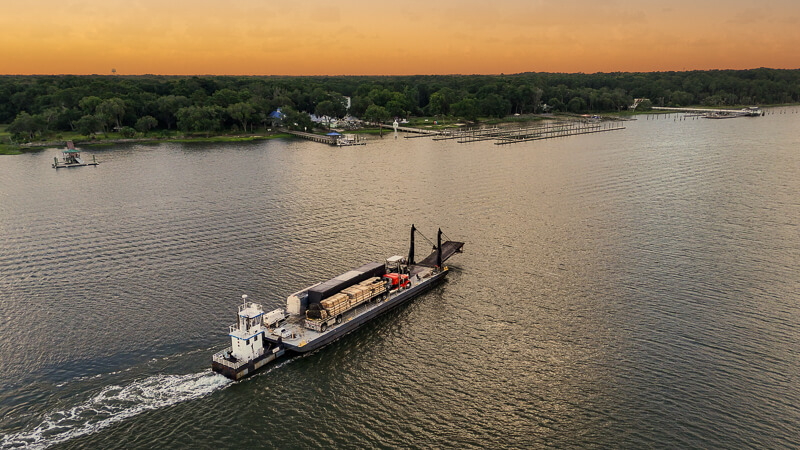
    At first glance, building a home on an island may seem similar to any other construction project. But in reality, every aspect—from materials to labor to scheduling—requires a different level of planning. Here’s what makes timber frame construction uniquely challenging on an island:

    1. Every Stick, Brick, and Person Arrives by Barge

    On the mainland, materials roll right off a truck and onto the job site. On an island? Not so much. Every single piece—timbers, nails, tools, even lunch—must be carefully staged, loaded, and ferried across the water. That means no last-minute hardware store runs, no quick resupplies, and no margin for error. The logistics resemble a military operation, requiring precision, planning, and a team that understands the stakes.

    2. Forget Something? Prepare for Costly Delays

    On a typical job site, a miscut timber or a forgotten handful of ¾” white oak pegs might cost you a day. On an island, that same mistake could set you back a week. There’s no quick trip to the supplier—every extra run across the water depends on barge schedules, tides, and availability, all of which are beyond your control. In remote construction, small problems don’t stay small for long.

    3. Rain, Tides, and Isolation Demand Next-Level Logistics

    On an island, nature calls the shots. Tides dictate when barges can run. Rain stalls work, but the crew is still on the clock. A passing storm can upend the schedule, while a broken-down barge can ripple delays across the entire project. It takes a certain mindset to thrive in conditions where predictability is a luxury.

    4. Food and Lodging: More than Just a Place to Sleep
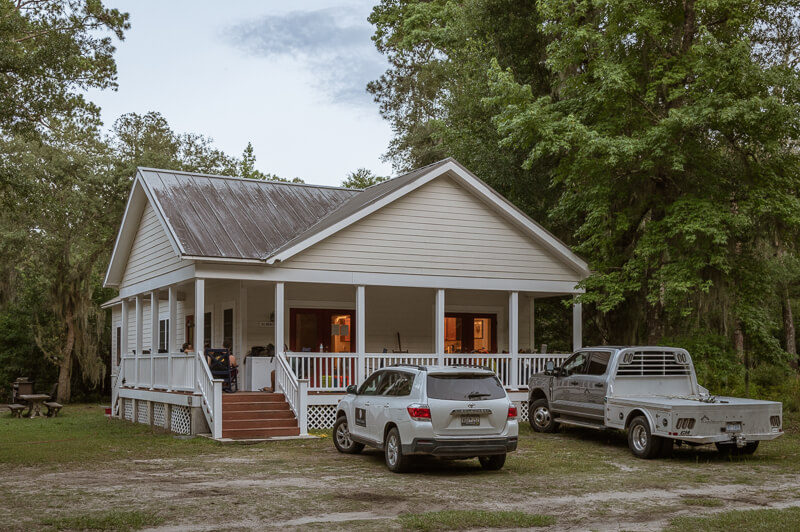
    Getting materials across the water is only part of the challenge—you also have to get the crew there and make sure they’re taken care of. Lodging is rarely luxurious, but it needs to be comfortable enough for a team working long, physically demanding days.

    And then there’s food. When the nearest grocery store is miles (and a boat ride) away, you don’t just “grab something” after work. That’s where having a crew member like Tommy makes all the difference. A former restaurant owner, he took charge of meals—wearing gloves, using a thermometer, and treating dinner prep with the same level of care and precision as a timber frame layout. One night, he put together a classic Low Country boil—shrimp, potatoes, corn, and sausage—the kind of meal that makes the challenges of building in a remote location a little more enjoyable, and a lot more memorable.


    Why Timber Frames Are Ideal for Island Homes

    1. Speed: Faster Assembly, Less Time on Site
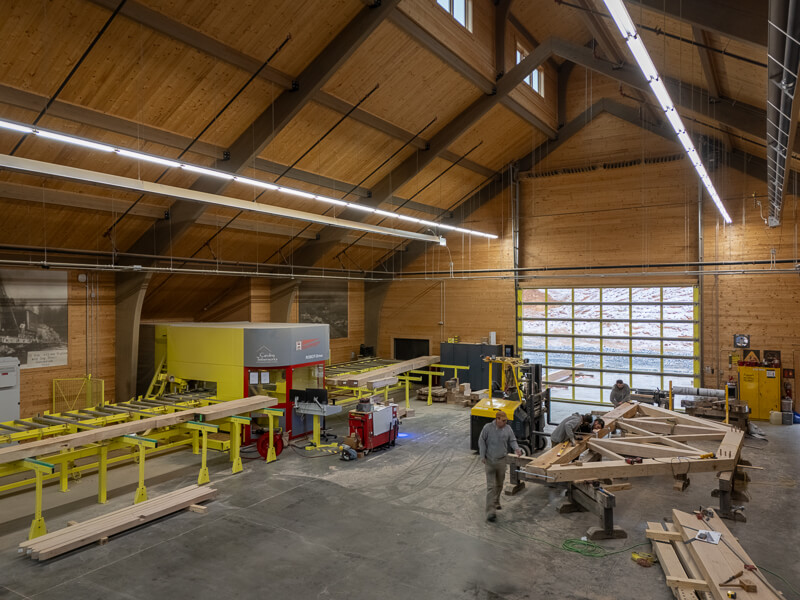
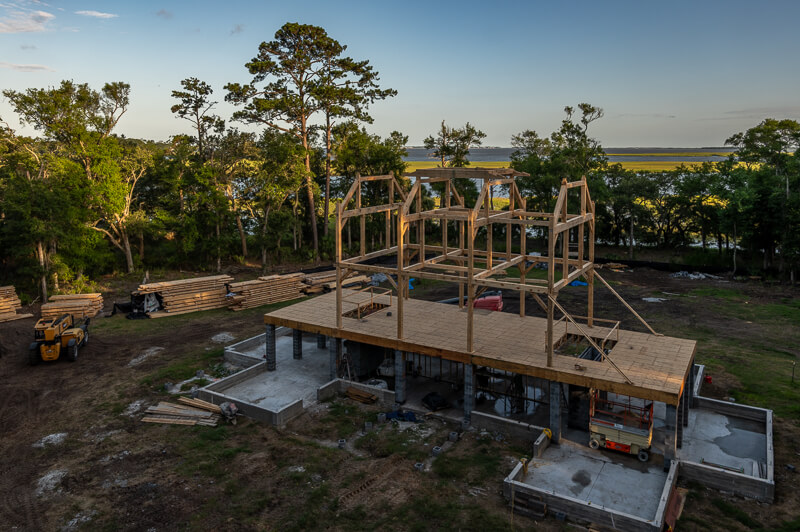
    On an island, every extra day of construction adds logistical headaches and costs. Timber framing changes the equation. Instead of cutting and fitting each piece on-site, the entire structure is precision-cut in our shop using state-of-the-art CNC machinery. When the timbers arrive, they’re ready to go—slotted together like a giant puzzle by the same crew that fabricated them. What takes months with conventional framing can often be completed in weeks, minimizing time, risk, and weather exposure.

    2. Strength: Built to Withstand Nature’s Fury
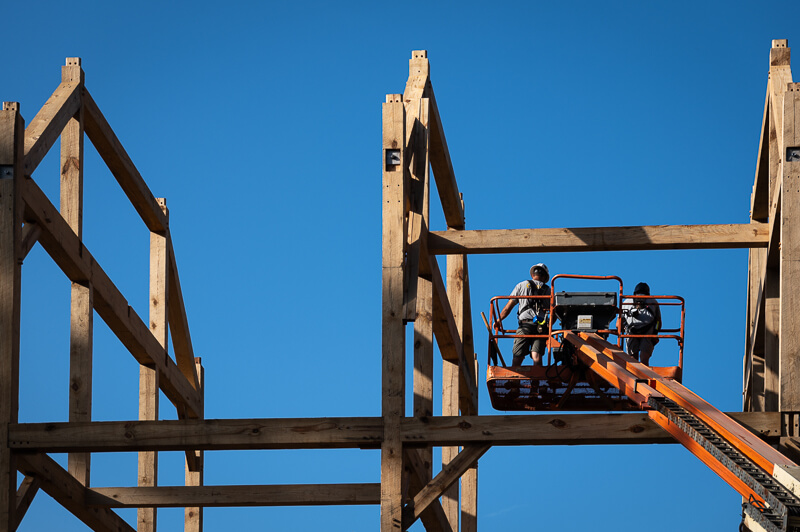
    Island homes don’t just need to be beautiful—they need to be strong. Timber frames are engineered to handle the extreme: hurricane-force winds, heavy storms, and the relentless coastal climate. The interlocking joinery and massive timbers create a structure that is as durable as it is stunning, standing firm where lighter, conventionally framed homes might flex or fail.

    3. Timelessness: Built to Last—and Loved for Generations

    Timber framing isn’t a trend—it’s a building tradition that has been relied upon for over two thousand years. Long before mass-produced lumber and steel-framed glass boxes, people built with heavy timbers because they worked. These homes don’t just stand the test of time structurally; they endure because people love them. Timber-framed homes are cherished, maintained, and restored rather than torn down for something new. Their warmth, character, and craftsmanship make them worth preserving—whether on an island or anywhere else.
    4. Less Waste, More Efficiency

    On the mainland, construction waste is an afterthought—just toss it in the dumpster and schedule a pickup. On an island, every scrap of excess material has to be barged back off, turning waste disposal into a costly logistical challenge. Because we pre-cut every timber in our shop, there’s almost zero job-site waste. Fewer cutoffs, no piles of unusable material, and no need for expensive, hard-to-schedule dumpster hauls.


    Considering Building on an Island? Here’s What to Know

    Island construction isn’t for the faint of heart, but with the right team, it’s absolutely possible. If you’re considering a timber frame home in a remote location, the most important decision you’ll make is choosing experienced professionals who understand the unique challenges involved.
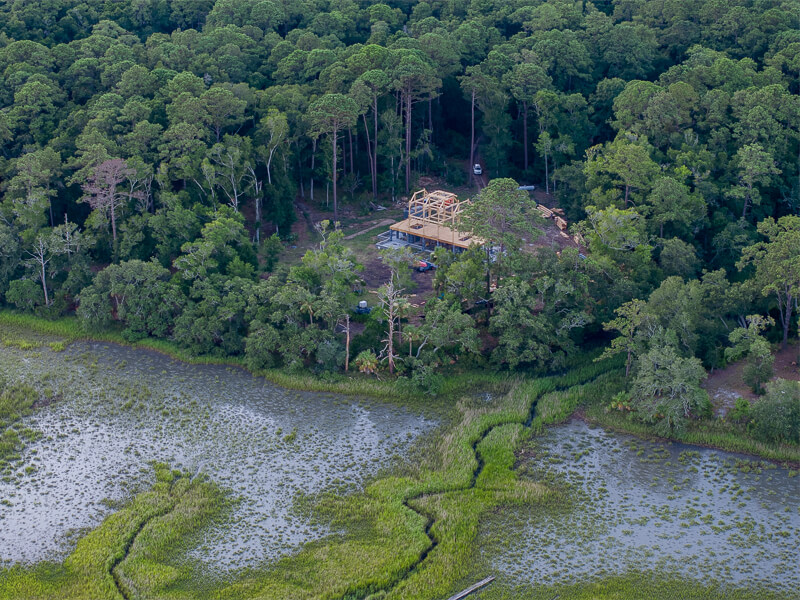
    At Carolina Timberworks, we specialize in tackling complex builds—whether on an island, in the mountains, or anywhere that demands more than just the ordinary. Want to talk about your project? Get in touch with us.


  • Google Fiber Charlotte: Benefits of Adaptive Reuse in Action

    Google Fiber Charlotte: Benefits of Adaptive Reuse in Action

    Key Takeaway

    Adaptive reuse transforms an old building for new uses rather than tearing it down. Google Fiber’s Charlotte office sits inside a post and beam industrial building more than a century old, which was restored rather than demolished. Keeping it intact saved material and held onto its original character.

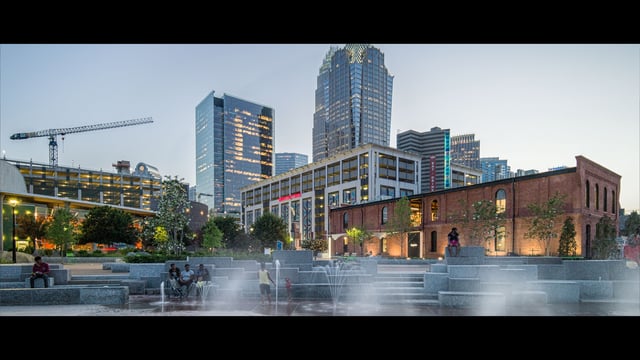
    Where Google Fiber chose to put their Charlotte office was a surprise: they re-imagined the typical high-tech office space by repurposing a more than 100-year-old historic post and beam building in an incredible adaptive reuse project. North Carolina-based Carolina Timberworks was proud to partner with Google to restore the historic reclaimed beams.

    What is Adaptive Reuse and How Does It Apply to Charlotte’s Google Fiber Headquarters?

    Adaptive reuse is the process of repurposing an existing building for new functions while maintaining the historical significance of the building. For example, converting an old printing facility into a community center or transforming an old roller rink into a theater.

    Or in this case, turning the Philip Carey Building into Charlotte’s Google Fiber HQ.

    Adopting an adaptive reuse model can preserve and rejuvenate historic buildings. This approach can also promote sustainability, slow urban sprawl, and encourage cultural development in urban areas.

    Why Sustainability Matters

    After demolishing an existing building, new construction requires a hefty amount of highly embodied resources (such as steel and aluminum) as well as new materials that produce large amounts of carbon emissions.

    Adaptive reuse is different. It recycles highly embodied resources and prolongs the building’s life. When a building lives longer, it protects from the high carbon footprint of demolition waste—not to mention construction waste.

    How Reuse Honors a Building’s Heritage

    The benefits of adaptive reuse go beyond sustainability alone. This method also honors a building’s heritage by conserving and maintaining the architecture and history. For example, an old bank turned into an office center may maintain its original vaults.

    Conservation through adaptive reuse can save many historic buildings from extensive modifications or even demolition. At the same time, this approach may also encourage related cultural development—which is something we can all enjoy.

    Key Challenges of Adaptive Reuse

    Of course, adaptive reuse isn’t without challenges. Lead paint, mold, and asbestos often surface in older buildings. Structural deterioration can also pose a safety concern. In many instances, building codes and regulations can be challenging to meet due to outdated and incompatible materials.

    Despite these barriers, the benefits of adaptive reuse outweigh the possible drawbacks. We find that it’s important to focus on the benefits rather than the challenges in order to improve sustainability and preserve the historical significance of these buildings.

    How Does Carolina Timberworks Support Sustainability? 

    Wood is one of the very few renewable sources on earth. It’s also biodegradable and recyclable and it’s a carbon sink—meaning it stores more carbon than it releases. But that doesn’t mean we support the practice of chopping down fast-growing trees and turning them into inexpensive 2x4s.

    Instead, we believe that a functional and delightful timber frame is best realized with magnificent, mature trees. We honor trees that have produced oxygen and stored carbon for decades by turning them into structures that can endure for a century or more.

    We’re no strangers to reclaimed wood either. Did you know that some post and beam homes using recycled wood can be constructed without cutting down a single tree? Dedicated to sustainability, Carolina Timberworks strives to construct homes that will last for generations. After all, we find that buildings that are well-loved are also well-maintained. 

    Charlotte’s Google Fiber Building Project

    Google understands its footprint on the environment, an issue that’s always on our minds here at Carolina Timberworks. Did you know that renovating an old building like this releases 50 to 75 percent less carbon than building a new one from the ground up? We’re all for sustainable timber framing!

    Above all, Google wanted our team to develop an office space worthy of Google Fiber’s mission to deliver high-speed internet to Charlotte, North Carolina, and beyond. Google prioritizes speed and ambition – and they expected the same from our team. Critical deadlines? Not a problem: we do what we say we’re going to do when we say we’re going to do it.

    Of course, our reliability wasn’t the only reason Google contracted Carolina Timberworks for the Fiber project. Our experience using reclaimed wood for structural timber framing sealed the deal.

    After all, the average timber frame company doesn’t work with reclaimed wood at all. Those that do usually focus on decorative timber framing due to the challenges of structural timber framing with reclaimed wood.

    One wrong move can waste a lot of materials and labor, setting back a project significantly. Our team’s skill, experience, and background in structural timber framing ensured that we could deliver this project on time for Google.

    After meeting with the general contractor (Pepper Construction Company) and the owner’s rep, they looked at each other and said, “I think we’ve found our timber frame company.” We couldn’t agree more, and we were happy to partner with Lineberry Architectural Group, which produced the drawings.

    Carolina Timberworks is proud to add the Google Fiber Charlotte building to our growing portfolio of once-in-a-lifetime projects we’ve worked on across the United States. Our team’s strong background in structural timber framing leads to incredible adaptive reuse projects, as proven by being chosen by Google to lead the Fiber project.

    We rise to the task when other timber framing companies skimp on using reclaimed wood. And we strive to promote sustainability in timber framing — despite the many challenges.

    Read More: Is Timber Framing Sustainable?