Champagne timber framing on a (craft) beer budget
 After receiving the latest Carolina Timberworks newsletter, a potential client emailed a great question: “Can you show a recent home for a customer on a 300k budget, else this stuff is non-realistic to normal non-millionaire folks“.
My Emailed Reply About a Timber Frame Budget
With respect to non-millionaire projects, we do a lot of them in North Carolina and around the United States. One way to fit timber framing into the budget is to consider hybrid timber framing — i.e. timber frame only certain parts of the house as opposed to building a timber frame house. You might consider identifying an area or two within your plan that you might like to timber frame (for example the front entry and great room) and establish a budget. Then, give us a call and we’ll do our best to come up with something great that fits your budget. By the way, if the timber framing is structural (versus decorative) there is some cost offset savings to be realized (since the timber framing is replacing 2x conventional construction).
Admittedly, timber framing is more expensive than conventional construction, but it’s also for us non-millionaire folks. I have a timber framed heavy duty mailbox with post, one curved timber bracket at my front entry, and a timber framed garage/guesthouse.
Finally, you can design, cut, and raise the timber frame yourself. It’s a heavy lift (pun intended), but your ancestors probably did it, and people today find it highly rewarding. By the way, there are wonderful schools that teach introductory timber framing (Heartwood in MA, and Yestermorrow in VT).
A More Considered Reply on Timber Frame Cost
Most of the timber frames Carolina Timberworks builds are for architect-designed homes — so to be clear, we do not design timber frame homes. My personal design philosophy has been shaped by the architect-designed timber frames we’ve been involved with, as well as two books:
- A Pattern Language by Christopher Alexander
- The Not So Big House by Sarah Susanka
Sarah Susanka’s design philosophy might be summarized as follows: Keep your budget as is, but design a smaller home with less square footage. Spend the cost savings on great design, quality materials, and craftsmanship.

Suppose you want to budget for some timber framing in your home, have a smaller home design in hand, and have already chosen which areas of your home to timber frame. Here are some factors under your control that will determine how much your timber frame construction costs:
- The timber frame design itself. The simpler the timber frame design, the less expensive it will be.
- Your timber choices are varied, and certain timber species are less expensive than others.
- Within a given timber species, sometimes a lower grade is available that will produce a serviceable yet still beautiful (and less expensive) timber frame.
- Reducing timber sizes. If structurally feasible (here’s where quality timber frame engineering pays for itself), these savings can add up fast. For example, an 8×8 post has 36% less wood than a 10×10 post.
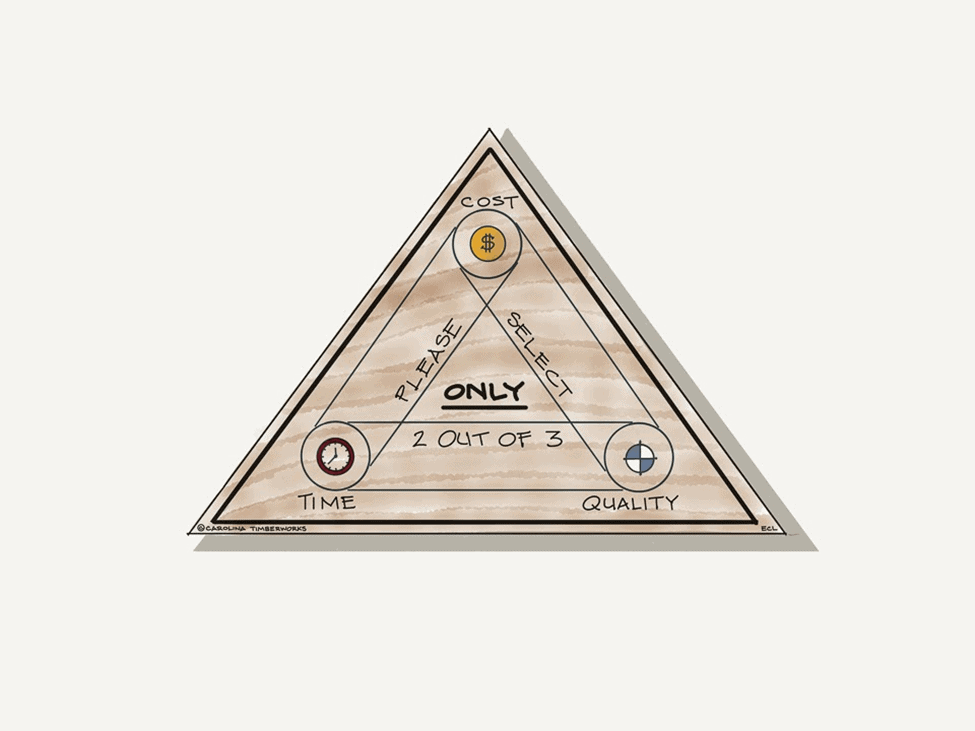
- The Golden Triangle applies to timber framing, just as it does to other purchases. Pick any two sides. You can have fast and cheap (but mediocre), good and cheap (but slow), or fast and good (but not cheap). You can’t have all three.
Need Some Ideas About Designing a Smaller Home So You Can Fit Timber Framing Into the Budget?
Since we don’t design homes, it was timely that Brice Cochran of Timber Frame HQ recently sent me some good advice on the topic.
Planning is the First Step
Whether you’re buying your first starter home, downsizing after the kids have flown the coop, or are financially limited to a smaller timber frame home, planning the most practical way to use your space can make that house seem more spacious.
It’s great when you can have a room for each of your family’s activities, but it usually isn’t feasible. By thinking ahead, planning your space, and getting creative, you can come up with a solution that gives everyone in the family the space they need for various hobbies and activities.
Consider the Things You Want to Do
Of course, you could make a laundry list of dozens of things you’d like to do in your home, and those may be good for your bucket list. However, think seriously about your family’s lifestyle options. What hobbies do your family get involved with and what responsibilities do family members have that require special space?
Be realistic about your needs, now and in the future. Make contingency plans and put future expansion and remodeling ideas into your design. If you envision a future addition, make sure you have the space on your property for it. Make sure there is easy access to add electrical, HVAC, and plumbing to the room when the time comes.
Rethink the Size of Rooms
It’s become very popular to have huge master bedroom suites and oversized spa bathrooms. It sounds cool to think of having a private getaway in your bedroom with plenty of space for a desk, a comfortable chair, or even an exercise machine. In addition, that spa bathroom that’s big enough for the whole family to use at once might seem glamorous, but when you’re planning a modest home, these two rooms may need some rethinking. The extra square footage you gain when you scale down those oversized rooms can go a long way to giving other smaller rooms the space they need to become roomy multi-purpose rooms the entire family can enjoy.
Hallways are a big waste of space. Plan your home to have the smallest square footage of the hallway as possible and use the extra space to enlarge other rooms.
Repurpose Spaces
If you never use your formal dining room and have ample space in your kitchen or family room, repurpose it as an office, hobby room, or exercise room. You don’t need a huge laundry room. In designing your home, consider using a closet for your washer and dryer.
Consider creating a centralized all-in-one space that includes your HVAC, plumbing system, storage, and laundry area. This compact use of space frees up valuable real estate for expanding smaller rooms.
Choose Furniture That Does Double Duty
Think further than a hide-a-bed when you’re considering furniture that can multitask. Of course, a convertible sofa is a good answer for a guest room that doubles as an office or study. There are lots of furniture options that make changing the role of your room easy and look great.
Certainly not cheap, but a great space saver for a guest room is a Murphy bed. These units have been around for years and today’s models are sleek and stylish. An adjustable height coffee table that rises to become a worktable or eating space is a perfect space-saving option for a desk or craft table in a study.
If you don’t have room for a desk, there are fold-down wall-mounted units that hide beneath an art print or mirror surface when it’s stowed away.
A long counter with base cabinets can be used as a desk or work area with plenty of storage space. This area can double as an entertainment area in a family room.
There’s a wide variety of furniture that incorporates storage into the base. Benches, footstools, low chests all are available with built-in storage space. Under-bed storage options vary from off-season clothing storage to a child’s toy storage and play surface to a pull-out trundle bed. Expandable tables are popular for feeding a crown or as a roomy work table.
Make Use of Lost Space
You may have some wasted space that can be converted to useful living space. The area beneath the stairs can serve a number of purposes. Open up space and create a compact workspace with a built-in desk and shelves. Another option is to create a storage space with a closet or a wall filled with drawers. Depending on its location, it could become a cozy reading nook, wet bar, or a diminutive powder room.
Space under the eaves can be fitted out with drawers for built-in storage, or if there’s enough headroom, lay down sturdy flooring and use it for long-term storage.
The most overlooked and underused space in most homes is the vertical wall space. Shelving can be installed around doors, above and adjacent to windows, in a wide hallway, and can reach to the ceiling. With all the added storage that doesn’t take up floor space, you can minimize bulky furniture like dressers and cabinets. You’ve opened up the room to accommodate the things you need for your multi-purpose plans.
Spend time planning how you’ll realistically use your home and develop a strategy to make the most of your home’s square footage. You may be surprised at how much you can do with the space you have.
Finally, you might enjoy this article about the low cost of quality: https://www.carolinatimberworks.com/a-return-to-quality/